I get asked about cost more than almost anything else. People want a number before they have even settled on an idea and I understand why. A sleeve is a serious commitment of time and money and you want to know what you are walking into before you apply for a consultation.
The honest answer is that there is no single number for a realism sleeve, because the cost comes from the work itself rather than a fixed price list. What follows is how I actually think about cost, so you can plan properly instead of guessing.
Why I do not quote a flat price for sleeves
Every sleeve I do is different, because every person's idea, skin and anatomy are different. A sleeve built around one large portrait with open background reads very differently to a sleeve packed with several smaller elements and the hours involved are not the same.
Cost in realism work is really a reflection of time and time is driven by detail, saturation and the amount of skin being covered. A design with smooth grey wash gradients built up in controlled layers takes longer than bold linework, because the tone has to move from dark to light with no bands or patches and that only comes from patience.
This is why I would rather talk you through the actual piece at a consultation than give you a number from a web page. If you want a general sense of how investment works across different sizes of project, my investment page covers that in more detail.
The things that genuinely change the price
Size is the obvious one, but it is not just about covering more skin. Detail needs space to breathe, so a sleeve with several realistic focal points needs enough room between them for each one to stay readable once healed. Cramming detail into a smaller area does not save money in the long run, because it usually needs correcting later.
Subject matter matters too. A single strong portrait with clean contrast is a different job to a mythology scene with multiple figures, architecture and texture, because every texture in realism asks for its own approach to mark making. Skin, fabric and stone all need to be rendered differently and that variety adds time.
Placement plays a part as well. A sleeve that flows with the arm, following the curves and muscles rather than sitting like a flat rectangle, takes more planning at the design stage, but it is what makes a large piece move well and look right from more than one angle once it is finished.
Why sessions are spaced out, not rushed
A realism sleeve is almost never finished in one sitting and that is by design rather than a limitation. Large realistic work benefits from spacing sessions apart so the skin can fully settle and repair between passes. That gives you a clearer canvas to work from and lets me see exactly how the first session has healed before I move forward.
This spacing is part of the real cost of a sleeve, not just the hours in the chair. If you have read my piece on how long a sleeve takes to finish, you will know that the gaps between sessions are just as important as the sessions themselves.
Paying for a tattoo that is planned, not just drawn
A good sleeve is planned before it is started. The consultation covers the idea, the reference images, the placement, the overall size and how the design will actually sit across the arm, so the work begins with a clear plan rather than being worked out as we go. That planning time is part of what you are paying for.
Strong reference material matters here too. Realism starts from a good reference with clear light and sharp detail and a poor or low quality reference limits how convincing the finished tattoo can be, no matter how skilled the artist is. Part of a consultation is making sure we have the right source material before any ink goes in.
Why cheap realism rarely stays looking good
A lasting tattoo rests on a few foundations, even saturation, strong contrast, clean technique and sound composition. If one of those is weak, the whole piece shows it and that usually shows up years down the line rather than on day one.
Solid areas need ink packed in evenly so they heal solid and not patchy and black and grey realism depends on a full range of tone, from deep blacks through every grey to clean skin. Skin itself is often the brightest highlight in a piece, so overworking the lighter areas to save time actually takes away the sparkle that makes realism convincing.
Fresh ink typically looks bold and crisp, whatever the quality of the work underneath it. Healed work is the true test of saturation, contrast and technique, which is why I judge my own work on healed photos rather than fresh ones and why you should judge any artist the same way before committing to a large project.
Ageing and touch ups as part of the real cost
Every tattoo softens a little with time as the ink settles and spreads, so a sleeve has to be designed for how it will look healed and in years to come, not only on the day it is finished. This is partly why sizing for detail matters so much. When realistic detail is packed too tightly, the small gaps between shapes close up over time and the image softens and blurs, whereas more size gives the detail room to stay readable.
Some healed sleeves benefit from a touch up once the skin has fully settled, particularly in large solid or smooth areas. That is a normal part of the process rather than a sign anything went wrong and it is worth factoring into your overall budget and timeline rather than treating it as an unexpected extra.
Sun exposure is one of the main things that fades and softens a tattoo over time, so protecting healed work from strong sun is one of the simplest things you can do to help it stay crisp for longer. My aftercare page covers the basics of looking after a new piece once you leave the studio.
Why I work by consultation rather than walk in quotes
Because cost depends so heavily on your specific idea, skin and placement, I do not work from a price list on the wall. I work by appointment only, from a private studio in East Kilbride, seeing clients from Glasgow and across Lanarkshire and Scotland more widely and every project starts with a proper conversation.
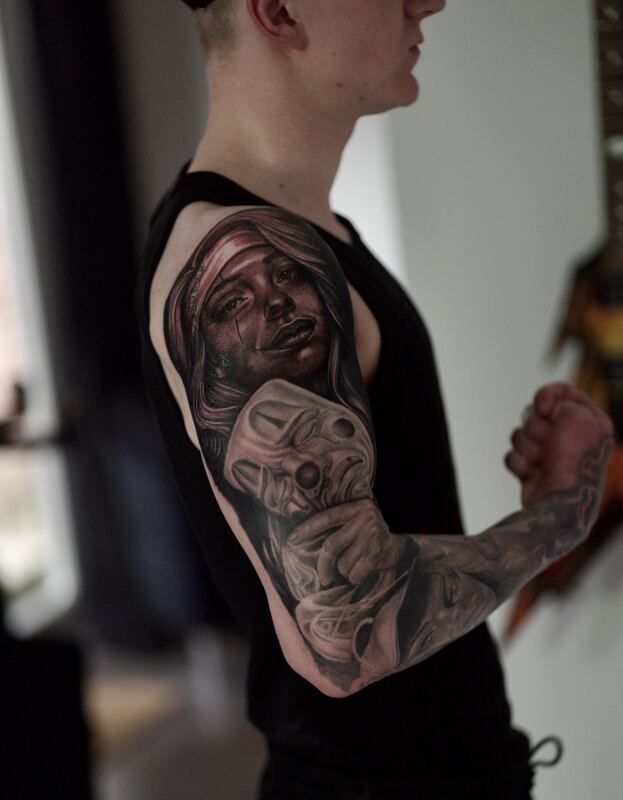
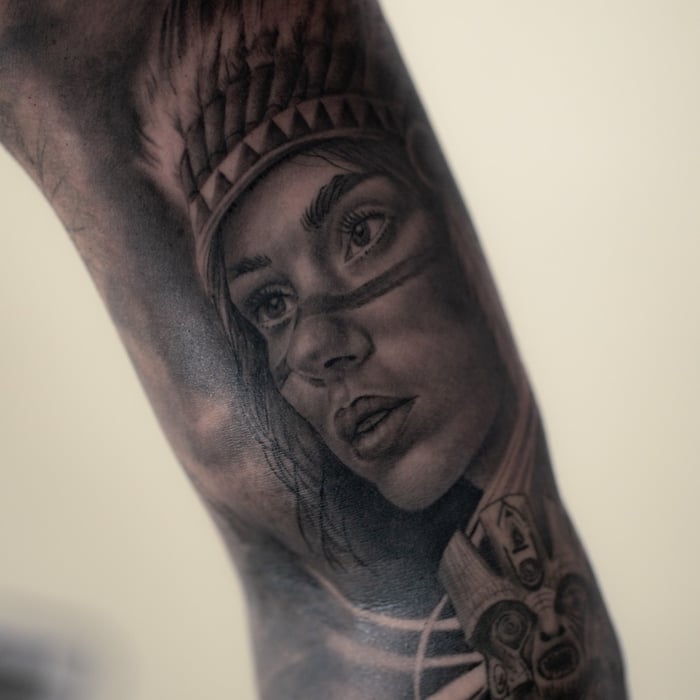
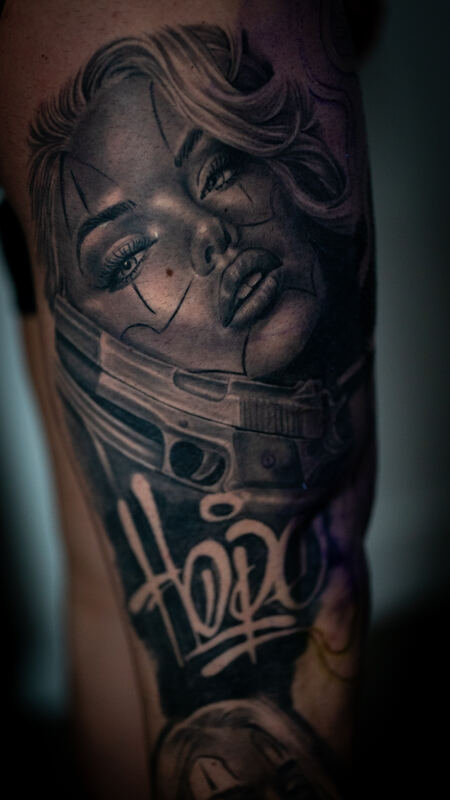
At a consultation we talk through your idea, look at reference material, discuss placement and realistic sizing and I give you an honest sense of time and cost based on the actual work rather than a generic sleeve rate. If you want to see the kind of large scale black and grey work I am talking about, my portfolio and my large scale tattoos page both show finished sleeves and back pieces in full.
Frequently Asked Questions
Common Questions
Not a meaningful one. A sleeve covers so much ground in size, detail and placement that any number given without seeing your idea and your skin would be a guess rather than a real figure. The consultation is where I give you something honest.
Generally yes, but detail and subject matter affect time just as much as raw size. A smaller area with several tightly packed realistic elements can take as long as a larger area with one clear focal point and open space around it.
I do not recommend it for large realistic work. Spacing sessions apart lets the skin settle and heal properly between passes, which gives a clearer result and that spacing is part of how a sleeve is planned rather than something to rush past.
It is sensible to. Some healed tattoos, especially those with large solid or smooth grey areas, benefit from a touch up once the skin has fully settled. It is a normal part of the process rather than a mistake, so building it into your expectations is realistic.
Yes. The studio is based in East Kilbride and I work with clients from across Scotland who are planning large scale black and grey realism and are happy to travel for a private, appointment only consultation.
This site uses a small number of cookies. Some keep the site working properly and can't be switched off. Others help me understand how visitors use the site and are only set once you agree.
Cookie Preferences
Necessary cookies are always on because the site needs them to function. Choose whether to allow the other two categories below.
Necessary
Required for the site to work properly and can't be switched off.
Analytics
Helps me understand how visitors use the site through Google Analytics, so it can be improved over time.
Marketing
Used for Google Ads to measure and improve advertising performance.